

Louisville Photo Tour: Water Tower, Museum Row and the Big Four Bridge
This tour follows the Ohio River through Louisville: from the Louisville Water Tower east of downtown to Museum Row on West Main Street, through the East Market District and back to the river for sunset on the Big Four Bridge. The Water Tower is best reached by car; the downtown stops are within walking distance of each other.
6 stops · about 6.1 mi between the stops in a straight line
The route
- Louisville Water Tower – 3.8 mi to the next stop
- Louisville Slugger Museum & Factory – 0.1 mi to the next stop
- Kentucky Science Center – 0.1 mi to the next stop
- Muhammad Ali Center – 1.2 mi to the next stop
- NuLu (East Market District) – 0.9 mi to the next stop
- Waterfront Park and Big Four Bridge
Planning the light
Start at the Water Tower in the morning, spend the day on Museum Row, and be on the Big Four Bridge for sunset. In late June golden hour begins at 8:30 p.m. and the sun sets at 9:10 p.m. in the west-northwest (301°); at the spring equinox it sets at 7:55 p.m. due west (271°); at the winter solstice golden hour begins at 4:45 p.m. and the sun sets at 5:26 p.m. in the west-southwest (240°). Blue hour ends at 9:41 p.m. in late June and at 5:56 p.m. in December.
1 Louisville Water Tower
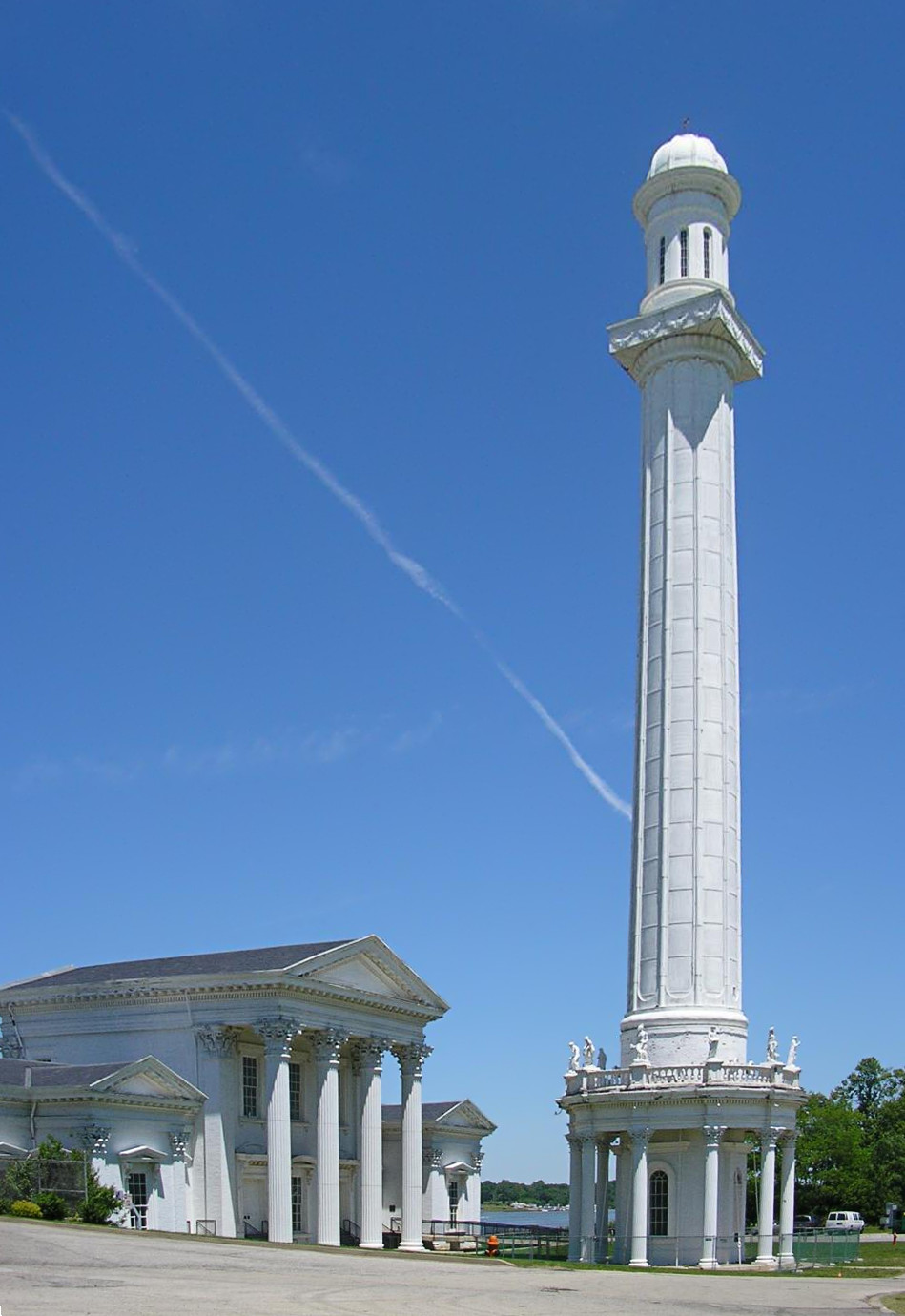
The Louisville Water Tower, built from 1857 to 1860 on a hill above the Ohio River, is the oldest ornamental water tower in the world; the photo shows the 169-foot tower. Architects Theodore Scowden and Charles Hermany disguised the industrial pumping station as a Roman temple, inspired by the French architect Claude Nicolas Ledoux, and tower and pumping station are a National Historic Landmark. Ten zinc statues stand on pedestals above the balustrade; a tornado in 1890 destroyed all but two of the originals. The tower stopped pumping in 1909, and the Louisville WaterWorks Museum opened here in 2014.
2 Louisville Slugger Museum & Factory
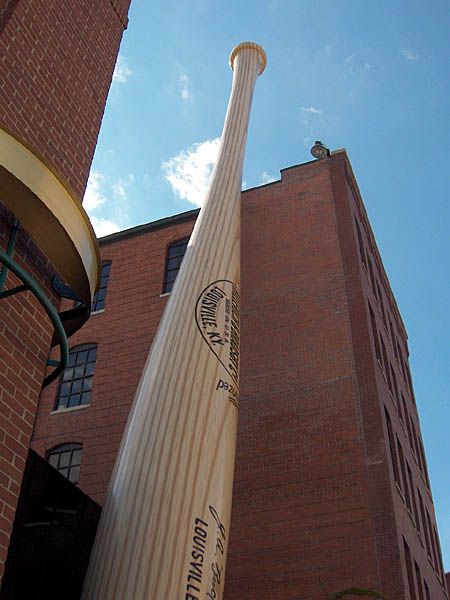
Museum Row on West Main Street starts at Eighth Street with the Louisville Slugger Museum & Factory, opened in July 1996 in a former tobacco warehouse. Outside stands the world's largest baseball bat, 120 feet tall and 68,000 pounds – the photo shows it greeting visitors at the entrance. Inside, the museum tells the story of Louisville Slugger bats, and the factory is the fourth location where they have been made; family legend traces the first bat to 1884, when J. A. "Bud" Hillerich made one for Pete Browning.
3 Kentucky Science Center
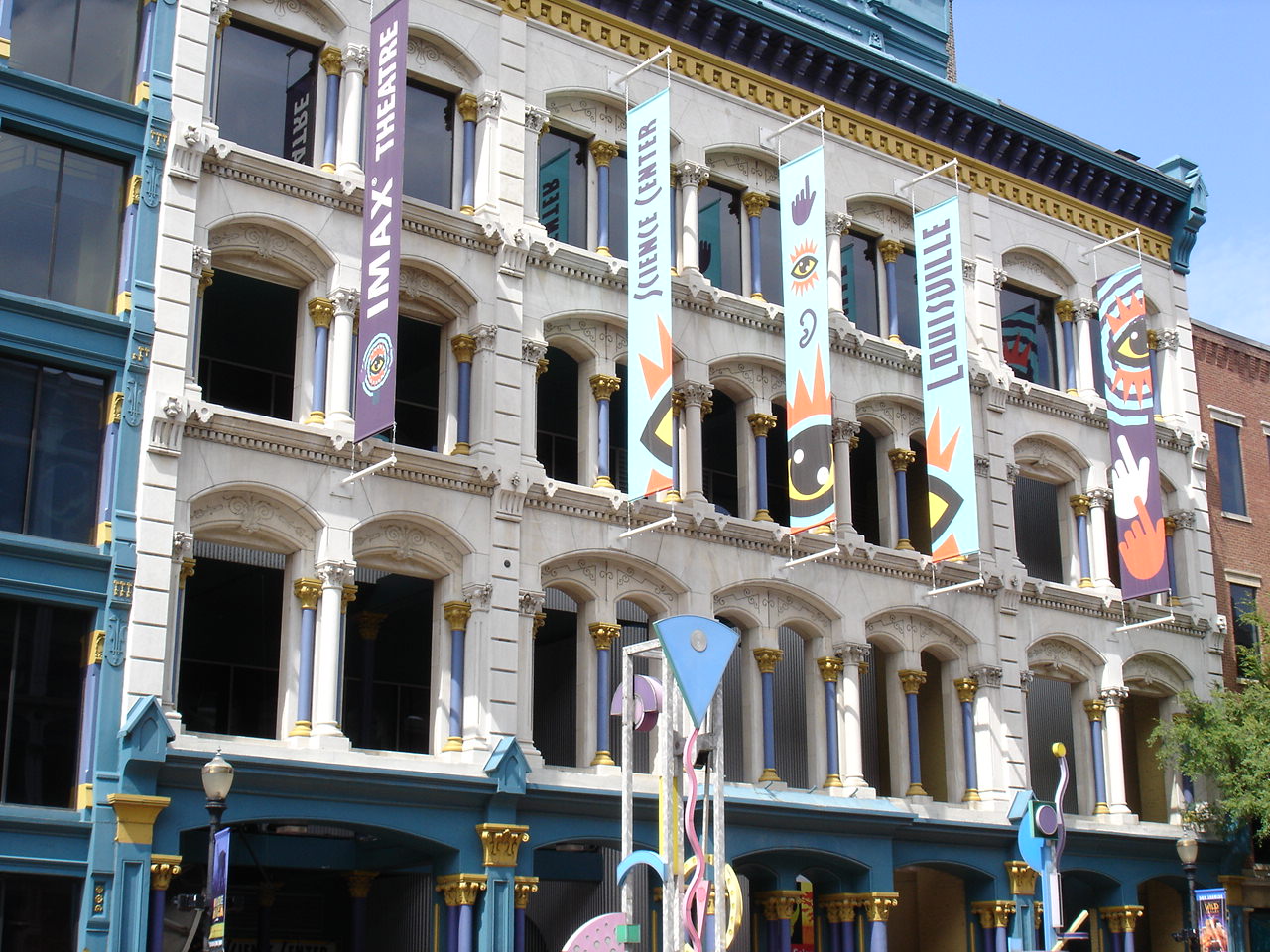
A few doors east, at 727 West Main Street, the Kentucky Science Center – the state's largest science museum, founded in 1871 as a natural history collection – occupies a limestone building with a cast-iron facade, built in 1878 as a dry goods warehouse. The museum moved in in 1977 and later added the neighboring Alexander Building from 1880. The cast-iron front is the subject for an architectural detail shot.
4 Muhammad Ali Center
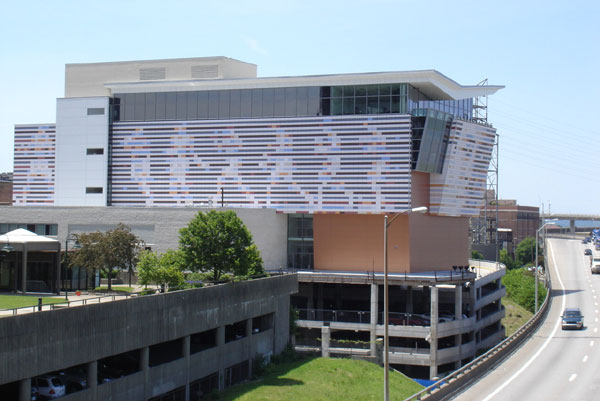
Muhammad Ali, a native of Louisville, founded the Muhammad Ali Center with his wife Lonnie Ali; the six-story museum and cultural center opened on November 19, 2005, with a two-level amphitheater and plaza. Its exhibitions are organized around Ali's six core principles, from confidence to spirituality, and in 2020 the center was added to the U.S. Civil Rights Trail. From the plaza, a 170-foot pedestrian bridge opened in 2013 leads to the Belvedere and the Waterfront – the route on to the river.
5 NuLu (East Market District)
NuLu – short for "New Louisville" – is the East Market District along Market Street east of downtown, known for its art galleries. Since 1983 it has been part of the Phoenix Hill National Register Historic District, and its buildings range from pre-Civil War Federal-style townhouses and shotgun houses to Italianate and Victorian structures. The Green Building, built in 1891 for Sternau's Dry Goods, became Louisville's first commercial building with LEED Platinum certification in 2010. The mix of styles along one street makes a series of facade photos.
6 Waterfront Park and Big Four Bridge
The tour ends in Louisville Waterfront Park, an 85-acre park on the Ohio River built on former scrap yards and dedicated in 1999. A spiral ramp in the park leads up to the Big Four Bridge, a six-span truss bridge completed in 1895 and rebuilt in 1929. Taken out of rail service in 1968 and left without approaches – the "Bridge That Goes Nowhere" – it has carried pedestrians and cyclists to Jeffersonville, Indiana, since 2013. It is 2,525 feet long, and its largest span measures 547 feet. The photo shows the western, downstream side; that side faces the sunset, whose times are under "Planning the light" above.
More photo spots in the city are on the Louisville photo guide.
More photo tours nearby
- Louisville Photo Tour: Churchill Downs, Cave Hill and Floyds Fork
4 stops – Photo tour beyond downtown Louisville: Churchill Downs and the Derby Museum, the Louisville Zoo, Cave Hill Cemetery and the Parklands of Floyds Fork. - Cincinnati Photo Walk: Art Museum, Eden Park and Mount Adams
4 stops – Photo walk in Cincinnati: the Cincinnati Art Museum, Krohn Conservatory, the lakes and overlooks of Eden Park and Immaculata Church on Mount Adams. - Downtown Indianapolis Photo Walk: From Mass Ave to White River State Park
9 stops – A photo walk through downtown Indianapolis: Mass Ave, the War Memorial, Monument Circle, the Canal Walk and sunset at White River State Park.