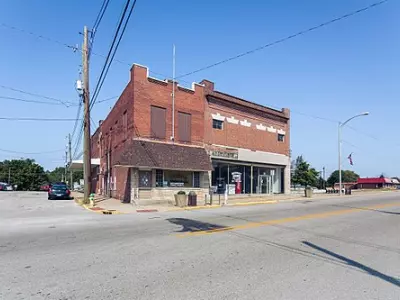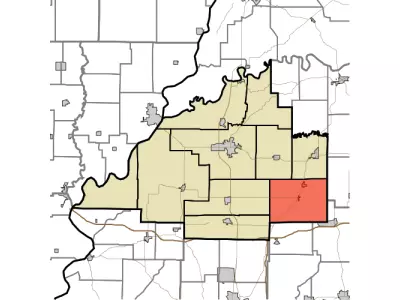
What makes Somerville sights so special is the unique mix of historical silence and the quiet noise of lunch when I depart from the I‐64 and cross the small fields of Barton Township. I have to admit that I don't understand all the hype about small towns in the Middle West, but here the story actually has something to tell: Founded in 1850, Somerville grew thanks to the railway line that once led from Chicago to New Orleans, and since then remained a quiet anchor in rural Indiana. The old brick houses on the main road remind of the time when the municipality was still an important hub for cereals and cattle – a charm that today is only found in the façades and the few but proud inhabitants.
When I stroll through the small park, I see children who ride over the headstone paver with squeaking skateboards, while the older ladies on the benches exchange their daily news – an image that sounds almost too cheesy when you haven't seen it yourself. The next supermarket is just a short detour over the County Road 300, and the local diner serves the best pancake in the 30 miles radius – no joke, that's really good. For travellers who do not want to land at major airports, Evansville Regional Airport is only half an hour away, and from there, Somerville can be easily reached by car. I like not being overrun here by tourist crowds; Instead you get a real piece of Indiana that you rarely find in travel guides. And that's exactly what makes the Somerville sights an underestimated jewel for those looking for the authentic.
With the map tool, you can plan the ideal location for a photo online in advance – taking into account the sun's path and the surroundings.
Here's how it works:
Advantage:
You can assess light, perspective and location before visiting the site – ideal for photography, sunrises and sunsets.
To find the exact point where the sun disappears behind the skyline, use the azimuth display on poi-travel.de. In Somerville, the sun travels further northwest below the horizon in summer, while in winter it takes a more southwesterly angle. With the embedded line on the map, you can determine your tripod position down to the metre.
The old Gibson County Courthouse in Princeton is what I would call the “stone heart” of the region – an impressive brick building dating back to 1884, which has more stories to tell than some guides. I once experienced a city tour day with a retired judge who told me about the “big battle” of the 1930s between the marble pillars, while a light rain shined the street outside. Parking is almost always a Klack in the small city centre, as long as you don't come on Saturday night, then parking becomes a small adventure.
Only a few blocks away is the Gibson County Historical Museum, a place that I would like to describe as a “box full of dust, but with heart”. The exhibition about the railway era is really great, and I even found an old diary that belonged to a farmer from the 1910s – a real find that makes the picture of the hard work here alive. The entrance is free, and the staff makes you feel almost like a relative when you ask for the way to the café.
If you have enough of historical walls, the road leads south to Patoka Lake, the largest lake in the area, where anglers, boaters and picnic lovers try their luck equally. I spent a weekend there interrupted by a sudden thunderstorm – that was annoying, but the thunder over the water was somehow poetic. Access to the lake is well signposted, and parking at the main dock is usually free, except during the annual regatta, then you have to go a little further.
A short detour to the east takes you to the banks of the Wabash River, where the Gibson County Riverfront Park is located. Here you can not only fish, but also just let the soul dangle while the sun goes down above the river. I remember an evening when a local musician unpacked his guitar and played some blues songs – that was more entertainment than any show in the cinema. The parking lot is usually sufficient, but at weekends the places fill up quickly because families grill here.
Another highlight I don't want to mention is the Gibson County Fairgrounds, which will be the scene of the largest fair in the region every year in August. The mix of rides, local arts and a lot of food stands is a bit like a mini-state fair, only with more heart and less tourist crowds. I tried the famous “Fried Corn on the Cob” there – no joke, that was better than anything I ever had at a leisure park. Parking is a children's game at Fairgrounds because the terrain was built for such events.
Whether you’re looking for historic buildings, pure nature or the colorful driving on the Fairgrounds – the surroundings of Somerville offer more than enough fabric for a varied trip. Those who want to experience the authentic Indiana should not only confine themselves to the city, but the many Somerville Attractions in the area.
This guide invites you to explore with me a small but surprisingly charming spot Indiana, which I have been secretly a “secret oasis” since my childhood.
For me, the Somerville Depot, a knorriger brick-built railway station, which today serves as a museum. I have to admit, I don't understand the whole “Railroad-Hype” completely, but the crunching sound of the old Telegrapher-Moresezeichen, which is still occasionally replayed here, has something magical. Parking is usually easy – a small parking lot behind the building is enough, except on Saturday afternoons when the local historian group is doing a special program and suddenly every place is occupied.
A short walk leads you to United Methodist Church from 1885. The Gothic façade is not what you would expect in Instagram feeds, but the wooden benches and the sounding organ play have a peculiar charm. I visited a Sunday service coffee meeting there once; the church was so warm that I almost forgot that I was here because of the architecture.
If you have a faible for quiet places, then the Somerville Cemetery That's right. Between weathered gravestones from 19. Century lies a small path surrounded by oaks, which invites to think. I found an old veteran grave there, whose inscription reminded me of the forgotten stories of the city – a real “Aha-Moment” when speaking the word “Somerville Sights” loudly and suddenly the rustling of the leaves sounds like applause.
Another highlight is the Town Hall, a simple brick building that since 1912 strikes the administrative heart of the municipality. The inner walls are decorated with old photographs showing how the town became from an agricultural settlement to the small but proud place I know today. Practical: The town hall has a small visitor area where you can take a few brochures for free – ideal if you want to learn more about local history.
For those who prefer something active, there is Somerville Community Center. There are frequent flea markets, dance evenings and even a weekly yoga course. I took part in a “Karaoke Thursday” there once; the mixture of slanted tones and loud applause was a real proof that the inhabitants of Somerville did not lose their humor.
A short detour leads you to Somerville Parka tiny green piece with an old playground and a bench that is perfect for watching the passing tractors. On a sunny afternoon you can hear almost the sum of the bees mixed with the distant rat of a tractor – a sound you only get here.
Lastly, Somerville Volunteer Fire Department Museum mentioned. It is not a big museum, but the old fire brigade and the crunchy, restored extinguishing vehicle from the 1950s give an insight into what the city holds together. I met a former firefighter there who told me that the “Rufen nach Hilfe” is still the loudest noise in the place – and that made my view of the community a little deeper.
Villages, towns, districts, places and Vacation destinations you should visit.
©copyright by POI-Travel.de
info@poi-travel.de